
4. Truth, Media, and Information Integrity: Facts Before Factions
An opening proposal for public discussion
A publicly directed movement cannot succeed if people cannot determine where information came from, who paid for it, whether it is authentic, and whether important claims can be challenged. Free people will never agree on every conclusion, but they need a fair opportunity to examine the same evidence.
The goal should not be to create a government office that decides what everyone must believe. Giving any political administration the authority to declare an official truth could become a tool for censorship and abuse. The better approach is to protect expression while requiring greater transparency around influential public communication.
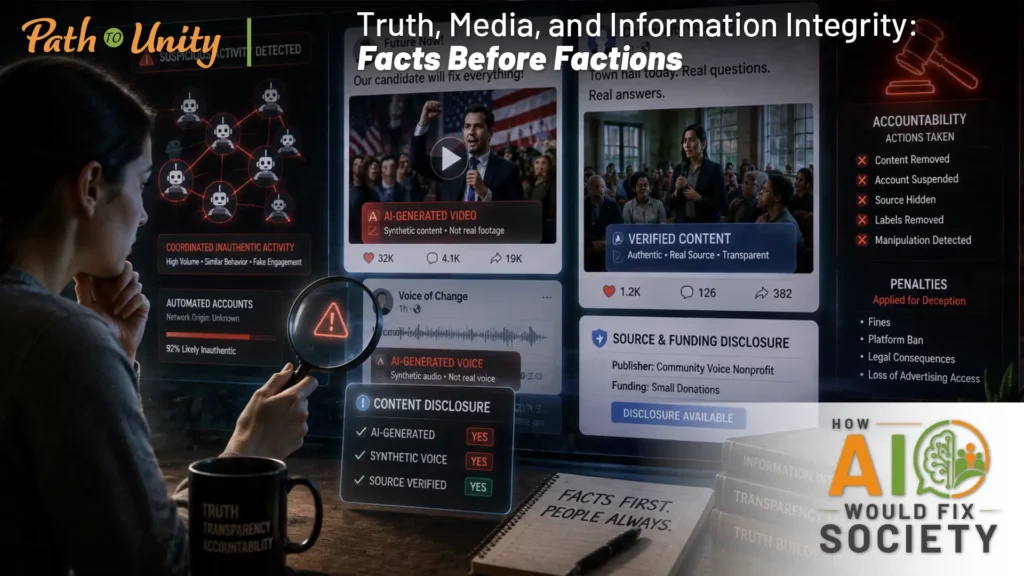
News organizations, political campaigns, advocacy groups, corporations, public agencies, and major online accounts should clearly distinguish reporting, opinion, advertising, satire, and artificially generated content. Significant financial sponsors, controlling ownership, paid partnerships, and material conflicts of interest should be easy to find.
Platforms should identify automated accounts and coordinated inauthentic activity rather than allowing bots to imitate genuine public support. Artificially generated images, voices, and videos used in elections or matters of public importance should carry clear and durable disclosure. Removing a label or hiding the original source should carry meaningful consequences.
Corrections should receive reasonable visibility. When a publisher or public agency materially changes a story, statistic, or official statement, the original claim, the correction, the reason, and the date should remain available. Quietly replacing false information does not restore public trust.
Path to Unity should require proposals to cite their sources, separate verified facts from assumptions, disclose the interests of the author, and allow competing evidence to remain visible. Moderation should focus on fraud, impersonation, threats, manipulation, and repeated disruption – not on eliminating peaceful disagreement.
The public does not need protection from every unpopular opinion. It needs protection from hidden sponsorship, manufactured consensus, fraudulent identities, deceptive media, and systems that reward outrage while concealing how information was selected and promoted.
Questions for the Conversation
How should reporting, opinion, advertising, satire, and AI-generated material be labeled?
When should the source and funding behind influential public content be disclosed?
How should platforms identify bots and coordinated manipulation without suppressing real people?
What correction standards should apply to news organizations, governments, campaigns, and large online platforms?
How can Path to Unity protect open debate while requiring evidence and authenticity?
Responses